

Infrastructure Services That
Power Modern Business Success
Your business infrastructure forms the backbone of every digital operation you perform. Modern organizations demand reliable, scalable, and secure technology foundations. Inventiv Technology delivers comprehensive infrastructure solutions that transform how businesses operate.
We specialize in designing, implementing, and managing enterprise-grade infrastructure systems. Our expertise spans from core network architecture to advanced virtualization platforms. Companies across industries trust us to build technology foundations that drive growth.
Our infrastructure solutions are built with scalability, reliability, and performance in mind, ensuring your business can adapt to evolving technological demands. From deployment and optimization to ongoing maintenance and support, we provide end-to-end services that maximize operational efficiency and minimize downtime.

Ready to transform your infrastructure? Our specialists are available to discuss your specific requirements and design a solution tailored to your business needs. Partner with us to implement secure, scalable, and high-performance IT infrastructure solutions that drive business growth, improve operational efficiency, and support long-term digital transformation.
Comprehensive Infrastructure Solutions for Every Business Need
Modern infrastructure extends beyond physical hardware. It integrates on-premises equipment with cloud resources. This hybrid approach provides flexibility while maintaining control over critical systems. Businesses gain the ability to scale resources based on demand.
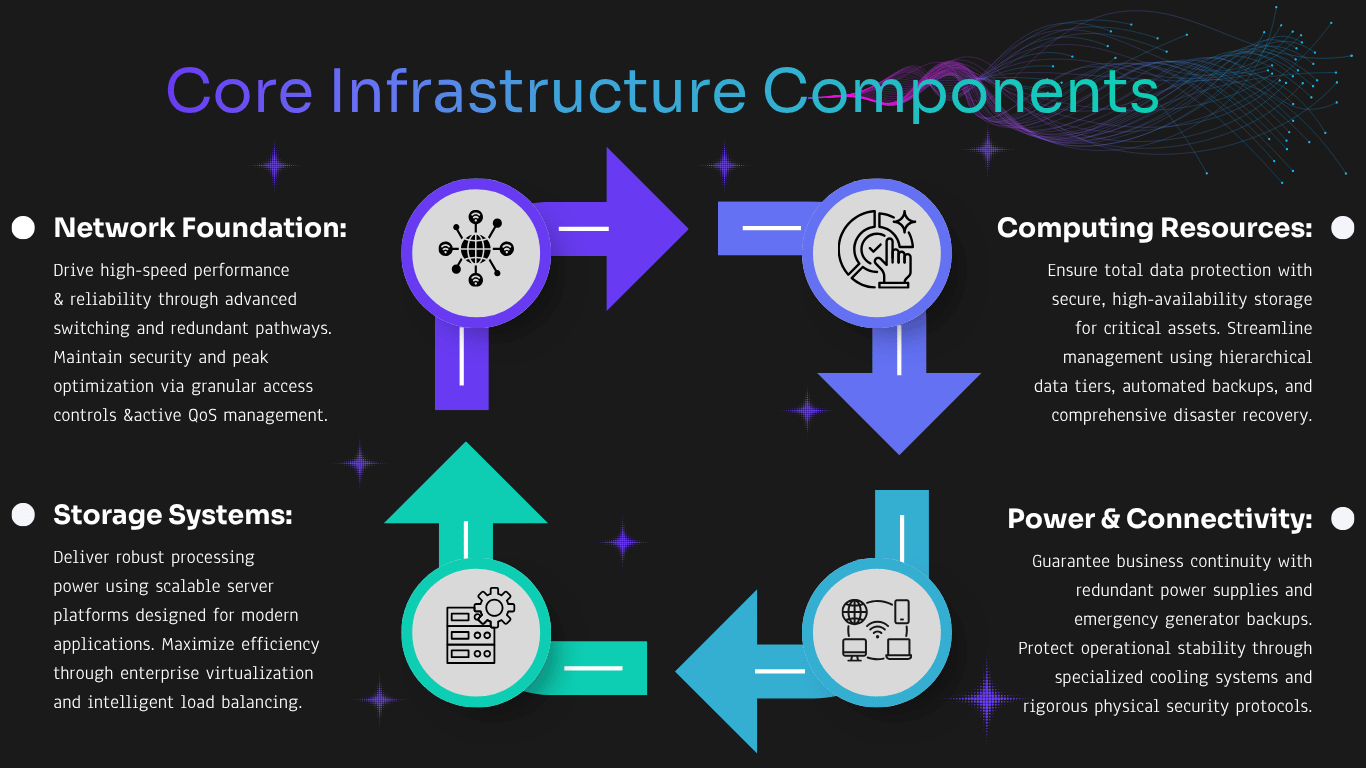
Enterprise Network Infrastructure That Connects Your Organization
Enterprise networks form the circulatory system of modern business. They enable communication between people, applications, and resources. A well-designed network supports current operations while accommodating future growth.
Network infrastructure projects require careful planning and execution. Organizations must consider bandwidth requirements, security needs, and scalability. The right network design balances performance with cost-effectiveness.
Local Area Networks
Local networks connect systems within facilities. Modern LANs support thousands of devices simultaneously. They provide the foundation for daily operations.
We deploy high-speed switching infrastructure throughout your facilities. Our networks support the latest WiFi standards for wireless connectivity. Users experience consistent performance regardless of location or device.


Wide Area Networks
Wide area networks connect distributed locations. Organizations with multiple offices need reliable inter-site connectivity. WANs extend your network across cities, states, or countries.
We implement diverse connection types based on requirements. Options include dedicated circuits, internet-based VPNs, and hybrid approaches. Each solution balances cost against performance and reliability needs.
Design Your Network Infrastructure
Our network architects will assess your requirements and design a scalable enterprise network solution built to support your business objectives from connectivity and security to future growth. Contact us today to begin planning a network infrastructure that keeps your organization running smoothly and securely.
SD-WAN Technology for Intelligent Network Management
Software-defined wide area networking (SD-WAN) is revolutionizing how organizations manage distributed networks. By separating network control from physical infrastructure, SD-WAN enables dynamic path selection, application-aware routing, and centralized management giving businesses greater visibility, agility, and control across every location.
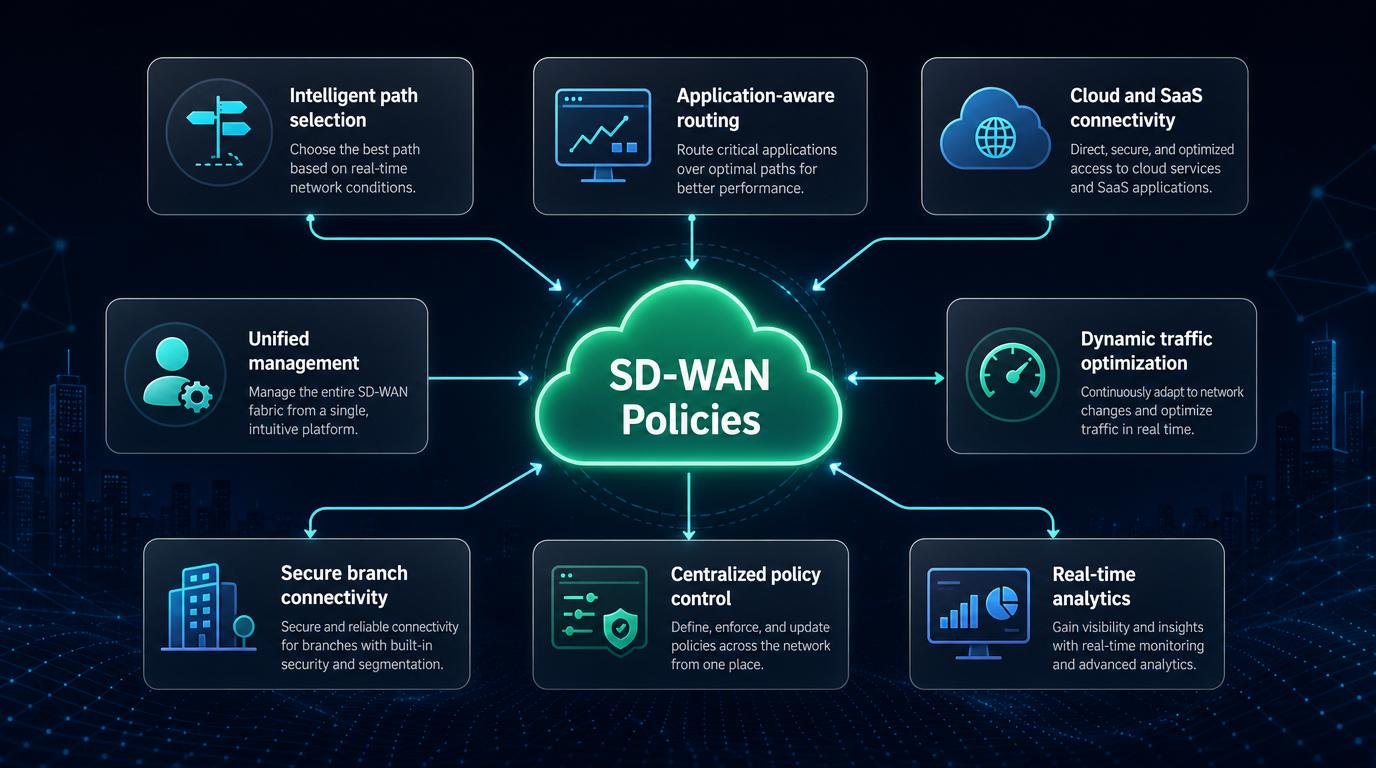
SD-WAN Benefits
Performance Advantages
- Application-aware traffic routing
- Automatic failover between connections
- Bandwidth aggregation across circuits
- Reduced latency for cloud applications
- Real-time traffic prioritization
- Optimized performance across cloud environments
Cost Benefits
- Reduced reliance on expensive MPLS circuits
- Lower bandwidth costs through internet usage
- Simplified network management reducing labor
- Faster deployment of new locations
Security Features
- Integrated firewall capabilities
- Encrypted tunnels between locations
- Segmentation for sensitive traffic
- Centralized security policy enforcement
- Threat detection and prevention
- Secure direct internet access
SD-WAN implementation requires expertise in both networking and application requirements. Our team analyzes your traffic patterns and business needs. We design solutions that prioritize critical applications while optimizing costs.
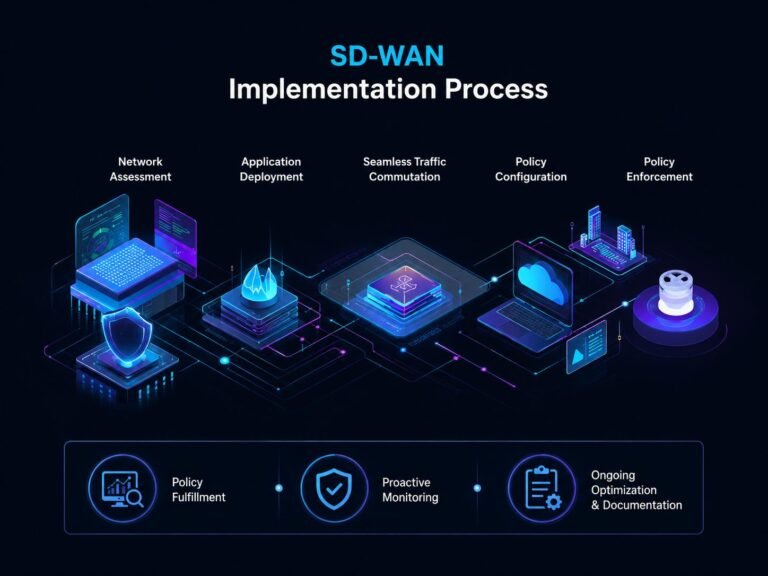
Implementation Process
1.Assess current network infrastructure and identify pain points
2.Map application requirements and traffic patterns
3.Design SD-WAN architecture aligned with business goals
4.Deploy edge devices and configure policies
5.Migrate traffic using phased approach
6.Monitor performance and optimize configurations
7.Provide ongoing management and support Our SD-WAN implementation process is designed to ensure a seamless transition with minimal disruption to business operations. We begin with a comprehensive assessment of your existing network environment, followed by strategic planning, deployment and configuration tailored to your organizational requirements.
Data Centre Infrastructure for Mission-Critical Operations
Data centres house the systems that run your business. These facilities require specialized infrastructure to ensure uptime and performance. Every component matters from power systems to cooling and network connectivity.
Modern data centre design balances multiple requirements. Facilities must provide reliable power with backup systems. Cooling systems maintain optimal temperatures. Physical security protects against unauthorized access. Network connectivity enables communication with users and external resources.
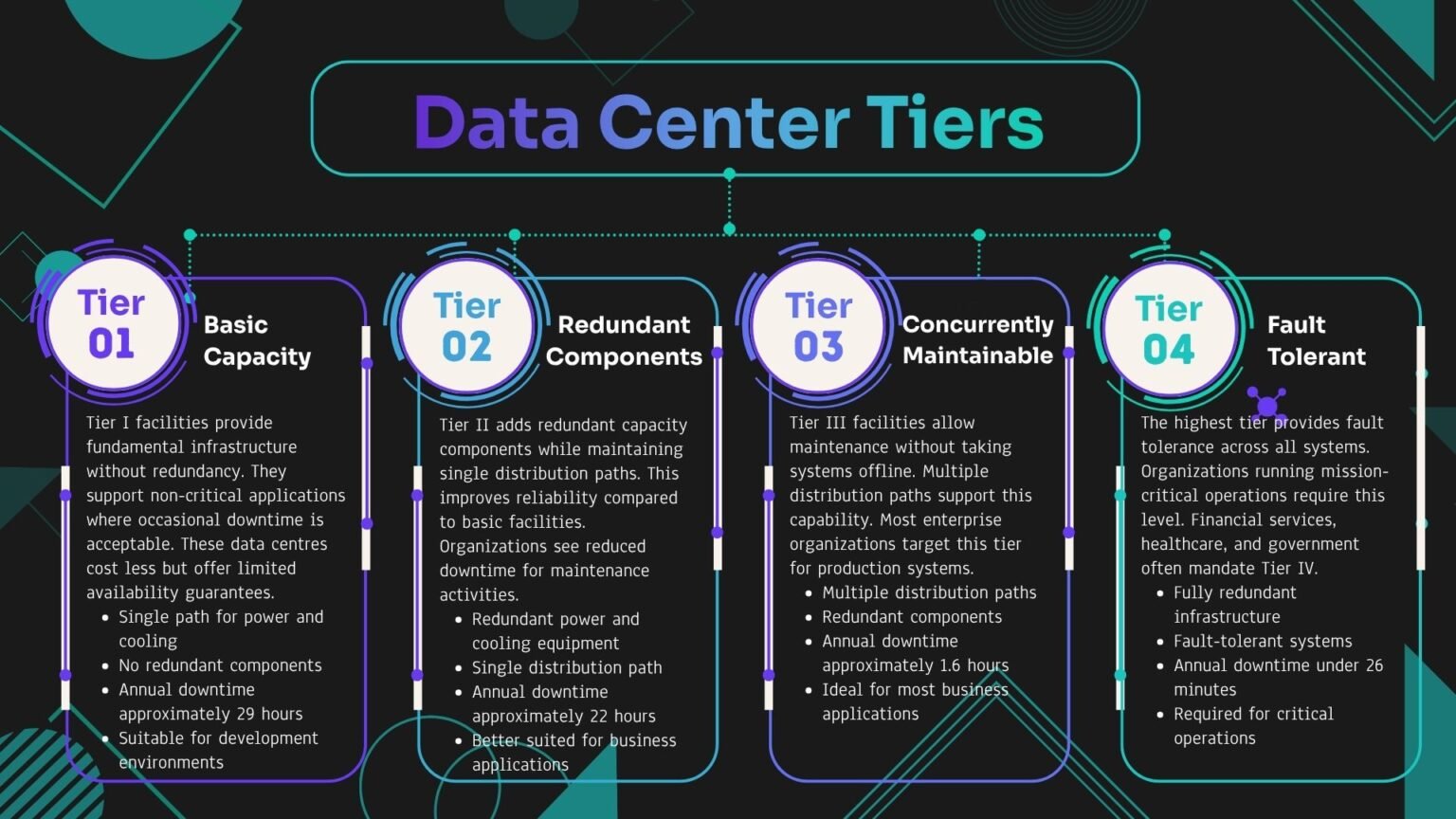
Data Centre Tiers
Industry standards define data centre reliability through tier classifications. Each tier represents increasing levels of redundancy and availability. Understanding these tiers helps organizations select appropriate infrastructure.
Compute Infrastructure Powering Business Applications
Compute resources provide the processing power that runs applications and services. Organizations need sufficient capacity to handle workloads efficiently. Modern compute infrastructure spans physical servers, virtual machines, and cloud instances.
Compute requirements vary dramatically across organizations and applications. Transactional systems need responsive processing. Analytics workloads benefit from parallel processing capabilities. Web applications require horizontal scalability to handle traffic spikes.
Processor Architecture Considerations
Modern processors offer varying characteristics suited to different workloads. General-purpose CPUs handle most business applications effectively. Specialized processors accelerate specific tasks.
CPU Selection Factors
- Core count for parallel processing
- Clock speed for single-threaded performance
- Cache size for data access speed
- Memory bandwidth for large datasets
- Power consumption for efficiency
Memory Requirements
- Capacity sufficient for working datasets
- Speed matching processor capabilities
- Error correction for data integrity
- Expandability for future growth
- Redundancy for high availability
Expansion Capabilities
- PCIe slots for accelerators
- Storage controller options
- Network adapter flexibility
- GPU support for specialized workloads
- Future upgrade paths
Optimize Your Compute Infrastructure
Let our infrastructure experts evaluate your compute requirements and design a solution that delivers optimal performance at the right cost point balancing scalability, reliability, and efficiency for your business. From on-premises to cloud and hybrid environments, we tailor every recommendation to your unique workload demands. Get a clear, data-driven roadmap tailored to your environment.
Storage Infrastructure for Data Management and Protection
Storage systems preserve your organization’s information assets. Data grows exponentially as businesses generate more digital content. Effective storage infrastructure balances capacity, performance, and cost.
Organizations face several storage challenges simultaneously. They must protect data against loss while ensuring quick access. Compliance requirements demand retention of specific information. Growth requires adding capacity without disrupting operations.
Storage Architecture Types
Different storage architectures serve distinct purposes. We help organizations select and implement the right combination for their needs.
Direct Attached Storage
Direct attached storage connects to individual servers. This simple approach works well for standalone systems. Performance is excellent because no network sits between server and storage.
However, DAS lacks sharing capabilities. Each server requires its own storage allocation. This can lead to inefficient capacity utilization across the infrastructure.

Storage Area Networks
SANs provide block-level storage to servers over dedicated networks. They offer the highest performance for demanding applications. Databases and virtual machine environments benefit from SAN architecture.
SANs support advanced features like snapshots and replication. Organizations implement these capabilities for data protection and disaster recovery. The complexity requires specialized expertise to design and manage.
Network Attached Storage
NAS systems connect to networks and serve files to multiple clients. They simplify sharing data across teams and applications. Management is straightforward through centralized interfaces.
File-level protocols make NAS ideal for unstructured data. Documents, images, and videos store efficiently. Many organizations use NAS for departmental file sharing and backup targets.


Object Storage
Object storage systems handle massive unstructured data volumes. They scale to billions of objects efficiently. Cloud providers built their services on object storage foundations.
This architecture suits archival storage, backup repositories, and content distribution. Objects store with rich metadata enabling sophisticated search and retrieval. Costs remain low even at enormous scale.
Storage Performance Optimization
Storage performance impacts application responsiveness. Users notice when systems respond slowly. We implement technologies that accelerate storage operations.
- Solid-state drives for high-performance tiers
- Automated tiering moving data between storage types
- Caching frequently accessed information
- Deduplication reducing redundant data
- Compression minimizing space requirements
- Quality of service preventing resource contention
Data protection requires multiple defensive layers. Primary storage protects against hardware failures through redundancy. Backup systems create copies on separate infrastructure. Disaster recovery capabilities enable operations continuation after major incidents.
We design comprehensive protection strategies addressing various failure scenarios. Local snapshots enable quick recovery from logical errors. Backup copies protect against infrastructure failures. Offsite replication guards against site-level disasters.
Virtualization Transforming Infrastructure Efficiency
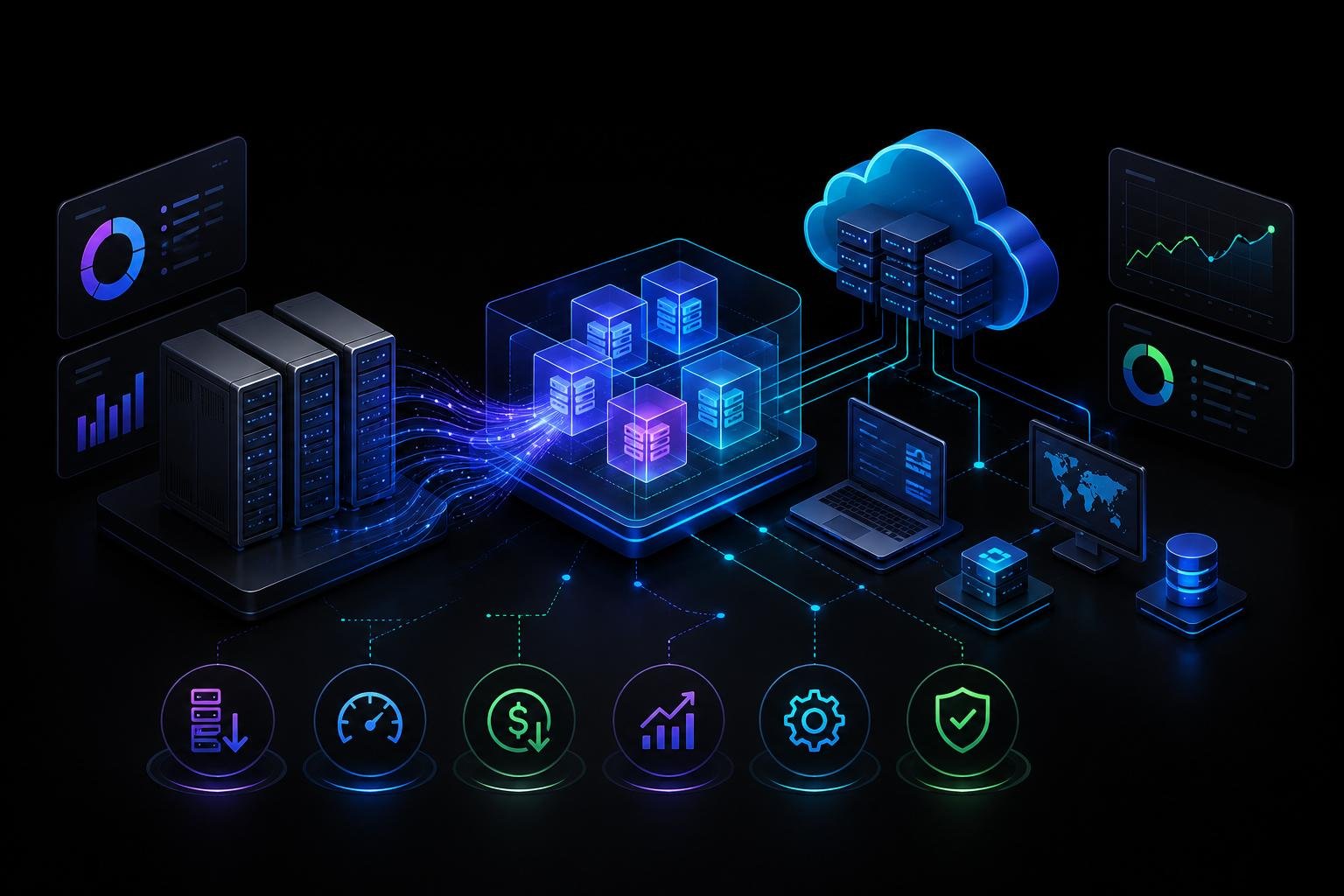
Virtualization technology has revolutionized how organizations deploy, manage, and scale their IT infrastructure. By separating workloads from physical hardware through abstraction layers, virtualization enables businesses to run multiple environments on shared resources improving efficiency and reducing hardware dependency. This separation delivers a level of flexibility and scalability impossible with traditional architectures, allowing organizations to adapt quickly to changing demands while optimizing costs and performance.
Virtualization Benefits
The advantages of virtualization extend far beyond simple server consolidation. By decoupling workloads from physical hardware, organizations gain powerful operational capabilities including improved scalability, faster provisioning, simplified disaster recovery, and centralized resource management that fundamentally transform IT service delivery and support long-term business agility.
Resource Optimization
Physical servers typically run at low utilization levels. Organizations provision for peak demand that rarely occurs. Virtualization enables higher utilization through workload consolidation.
Resources shift dynamically between virtual machines based on demand. Applications receive additional capacity during busy periods. Unused resources become available for other workloads. This flexibility maximizes infrastructure investment value.
Business Continuity
Virtualization enables sophisticated disaster recovery capabilities. Virtual machines replicate to secondary locations easily. Recovery procedures become simpler because hardware dependencies disappear.
Live migration moves running workloads between hosts without downtime. Maintenance windows shrink or disappear entirely. Applications remain available during infrastructure updates.
Rapid Deployment
Creating new virtual machines takes minutes rather than days or weeks. IT teams provision servers without waiting for hardware procurement. Development and test environments spin up on demand.
Template-based deployment ensures consistency across systems. Standard configurations reduce errors and simplify management. Organizations respond faster to business requirements.
Cost Reduction
Consolidation reduces hardware acquisition costs significantly. Fewer physical servers mean lower power and cooling expenses. Data centre space requirements decrease.
Management efficiency improves through centralized tools. Administrators manage more systems with the same staff. Automation handles routine tasks freeing people for strategic projects.
Why Businesses Choose Inventiv Technology for Infrastructure?
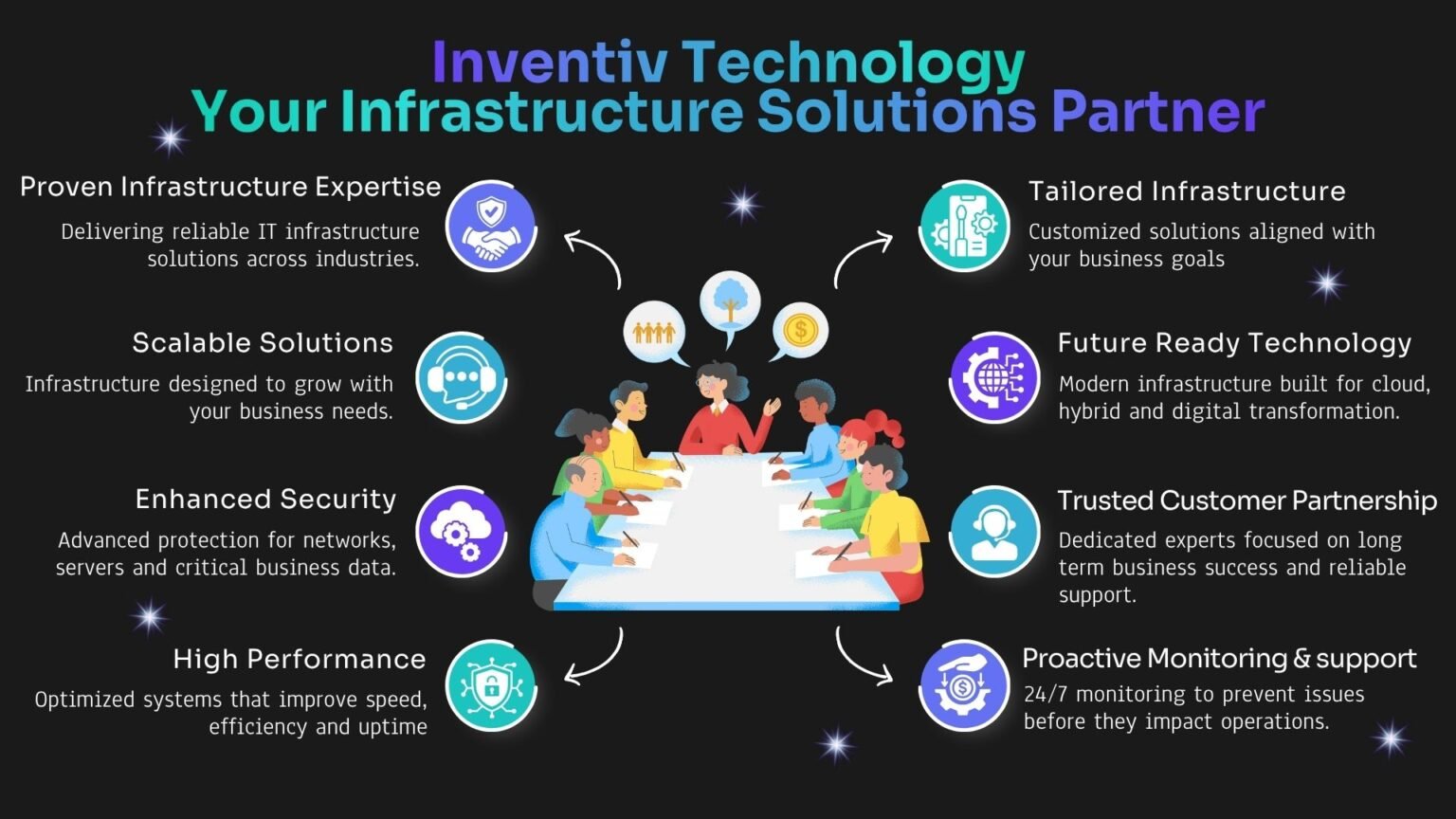
Selecting an infrastructure partner represents a critical business decision one that directly impacts your organization’s efficiency, security, and long-term growth. The right partner brings not just technical expertise, but proven experience and a genuine commitment to your success. Inventiv Technology delivers comprehensive infrastructure solutions backed by proven methodologies, industry best practices, and a client-first approach helping businesses build reliable, scalable foundations for the future.
Business-Focused Approach
Technology serves business objectives rather than existing for its own sake. We begin every engagement understanding your business goals. Infrastructure recommendations align with these objectives.
Budget considerations factor into all our proposals. We design solutions that deliver required capabilities within financial constraints. Options at various price points ensure appropriate fit for each organization.
Timeline requirements influence project planning and execution. We commit to realistic schedules based on scope and complexity. Milestone tracking keeps stakeholders informed throughout implementation.
Success Across Industries
Our portfolio includes infrastructure projects across diverse sectors. Financial services organizations trust us with mission-critical systems. Healthcare providers rely on our healthcare data protection regulations-compliant solutions. Manufacturing companies depend on our operational technology integration.
Each industry brings unique requirements and constraints. Healthcare demands strict privacy controls. Finance requires audit capabilities and disaster recovery. Manufacturing needs integration with operational systems. We understand these nuances and design accordingly.
Our Storage solution at Inventiv Technology delivers a reliable, scalable, and secure data storage infrastructure to meet the evolving needs of businesses. We provide customized storage solutions with high availability, redundancy, intelligent data management, and seamless integration to ensure secure data access, protection, and optimized performance. Our expert team ensures smooth implementation, ongoing support, and monitoring to empower businesses and drive operational efficiency.
With a focus on flexibility and future growth, our storage solutions are designed to adapt to increasing data demands while maintaining peak performance and reliability.

Partner With Infrastructure Experts
Join the organizations that trust Inventiv Technology for infrastructure excellence. Our team is ready to assess your requirements and propose tailored infrastructure solutions designed to support your business goals from planning and implementation to long-term support. Let’s build a smarter, more resilient infrastructure together.