




Professional Cloud Migration Services: Secure Your Digital Transformation
Moving your business infrastructure to the cloud represents one of the most strategic decisions your organization will make. Cloud migration enables organizations to achieve unprecedented scalability, enhanced security compliance, and operational flexibility while reducing infrastructure costs by up to forty percent.
Yet many businesses hesitate. Security concerns, compliance requirements, and fear of disruption create barriers to cloud adoption.
Inventiv Cloud eliminates these obstacles with comprehensive cloud migration services designed specifically for organizations demanding zero-compromise security and seamless transition processes.
Ready to Transform Your Infrastructure?
Get a free cloud migration assessment from our certified experts. Discover your optimal cloud strategy with zero obligation.
Understanding Cloud Migration
Cloud migration involves a strategic transition from traditional on-premises infrastructure to dynamic cloud environments. This process is not merely about moving data; it requires careful planning and management to ensure that all applications and workloads function optimally in their new settings. Organizations often face choices between different migration strategies, including lift-and-shift, refactoring, or complete re-architecture, each tailored to specific business needs.
Effective management of cloud migration encompasses continuous assessment and adjustment. Businesses must monitor performance and security throughout the transition to mitigate risks and ensure compliance with industry standards. A well-managed migration not only enhances operational efficiency but also lays the groundwork for future innovations.
Why it Matters ?
The significance of cloud migration cannot be overstated. In today’s fast-paced digital landscape, organizations that embrace cloud solutions can respond more swiftly to market demands, scale resources efficiently & reduce operational costs. The ability to adapt changes in the business environment is an advantage that can determine long-term success.
Moreover, cloud migration fosters collaboration and accessibility, enabling teams to work from anywhere while maintaining data integrity and security. As businesses continue to evolve, the strategic implementation of cloud technologies will be a cornerstone of their growth and resilience in the face of challenges.
Inventiv Cloud Migration & Management Services
Our comprehensive cloud migration services address every aspect of your cloud journey. From initial strategy development through ongoing management, we provide complete support ensuring your migration succeeds. We tailor our solutions to meet the unique needs of your organization, maximizing efficiency and effectiveness.
Secure Cloud Migration
Our migration process prioritizes security at every step. We implement encryption protocols, maintain compliance standards, and ensure zero data exposure during transition. Your sensitive information remains protected throughout the entire cloud migration process.
- End-to-end encryption during data transfer
- Compliance verification for regulatory requirements
- Security audit and vulnerability assessment
- Zero-downtime migration strategies
Managed Cloud Services
Post-migration support determines long-term cloud success. Our managed services provide continuous monitoring, optimization, and support. We handle infrastructure management so your team focuses on core business objectives.
- 24/7 infrastructure monitoring and support
- Proactive performance optimization
- Automated backup and disaster recovery
- Cost optimization and resource management
Infrastructure Management
Complex cloud environments require expert management. We configure, monitor, and optimize your cloud infrastructure for peak performance. Our infrastructure management ensures your cloud environment operates efficiently and cost-effectively.
- Multi-cloud and hybrid infrastructure support
- Scalability planning and implementation
- Network architecture and security configuration
- Performance tuning and capacity planning
Strategic Benefits: Why Organizations Choose Cloud Migration
Cloud migration delivers measurable business value across multiple dimensions. Organizations transitioning to cloud environments experience operational improvements that directly impact profitability and competitive positioning.
Operational Excellence
Cloud infrastructure eliminates traditional IT constraints. Resources scale automatically based on demand, ensuring applications perform optimally during peak usage periods without maintaining expensive excess capacity during slower times.
Management overhead decreases significantly. Cloud providers handle hardware maintenance, security patches, and infrastructure updates. Your IT team redirects effort from maintenance tasks to strategic initiatives driving business growth.
Disaster recovery capabilities improve dramatically. Cloud platforms enable automated backup processes, geographic redundancy, and rapid recovery procedures. Business continuity strengthens while recovery costs decrease.
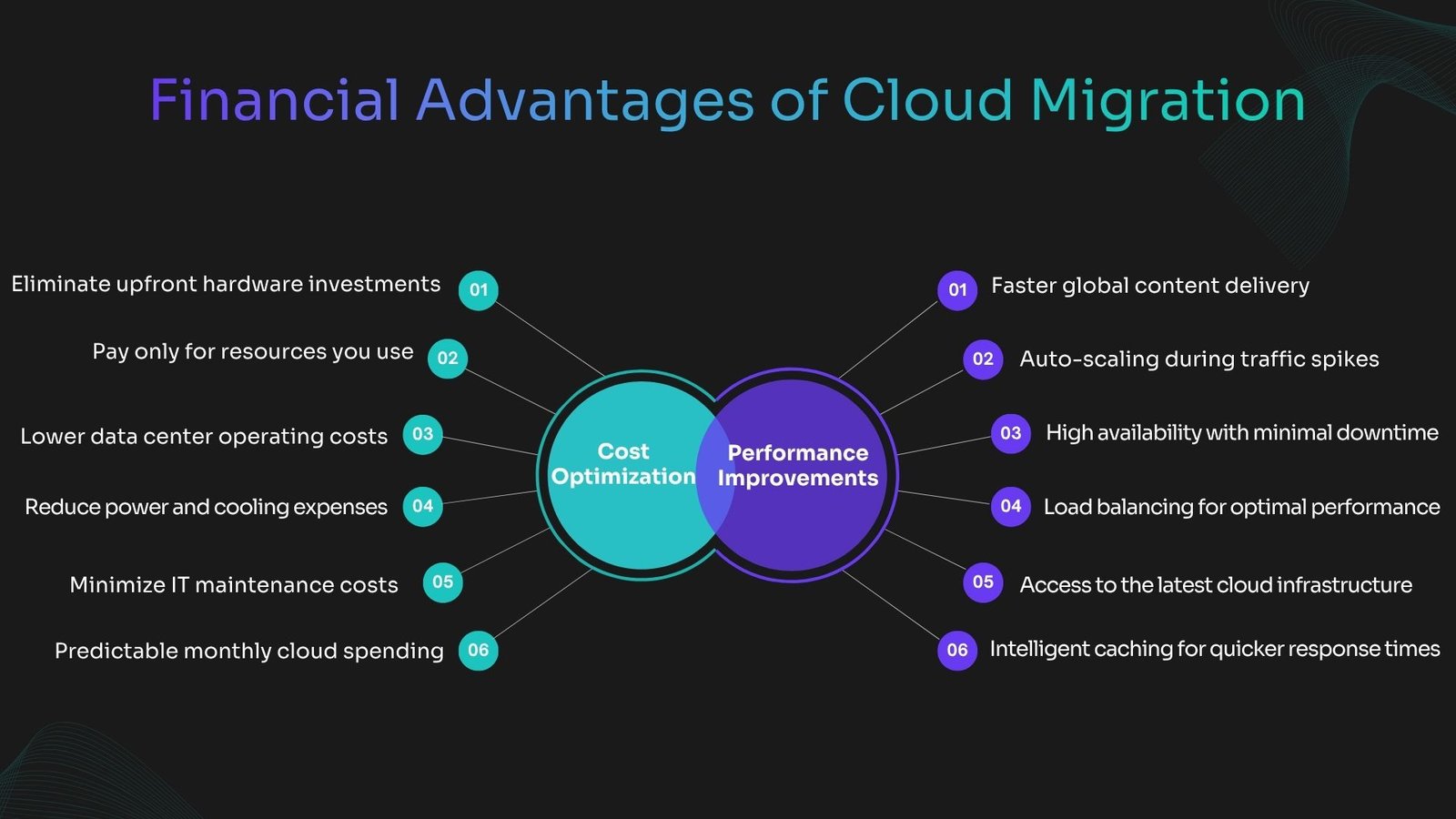
Financial Advantages
Financial Advantages Cloud computing offers significant financial benefits, including the elimination of hefty capital expenditures on hardware and a shift to a more predictable monthly cost structure. This model allows businesses to pay only for the resources they use, leading to optimized budgets and enhanced cash flow management.
Security and Compliance
Enterprise cloud providers invest heavily in security infrastructure exceeding what most organizations can implement independently. Multi-layered security approaches protect data through physical security, network isolation, encryption, and continuous threat monitoring.
Compliance requirements become manageable. Major cloud platforms maintain certifications for industry-specific regulations including HIPAA, PCI DSS, SOC 2, and GDPR. Organizations inherit these compliance frameworks, simplifying audit processes and reducing certification costs.
Cloud Migration Strategies: Choosing the Right Approach
Different applications require different migration strategies. We evaluate each workload individually to determine the optimal approach balancing speed, cost, and long-term value. Our team leverages industry best practices and insights to ensure that each strategy aligns with your business goals, maximizing efficiency and effectiveness throughout the migration process.
Lift and Shift (Rehosting)

The fastest migration approach available, this method requires minimal application changes and incurs lower initial migration costs. It allows for a quick transition to the cloud environment, making it ideal for legacy applications and serving as a solid foundation for future optimization.
Refactoring (Re-architecting)

Optimizing applications for the cloud platform significantly improves performance, enhances scalability and flexibility, and reduces long-term operational costs. By leveraging cloud-native features, organizations can achieve a higher initial investment that ultimately yields greater returns.
Hybrid Approach

Combining multiple migration strategies allows for a balance between speed and optimization, while also maintaining on-premise systems where beneficial. This gradual transition reduces disruption and provides the flexibility needed for diverse workload types, ultimately serving as an optimal risk management strategy.

Security and Compliance: Non-Negotiable Cloud Migration Priorities
Security concerns represent the primary obstacle preventing organizations from embracing cloud migration. Inventiv Cloud addresses these concerns through comprehensive security frameworks implemented throughout the migration process and maintained in ongoing operations. Additionally, our team continuously monitors these frameworks to adapt to evolving threats, ensuring that your data remains protected at all times.
Multi-Layer Security Architecture
Our security approach implements defense in depth, which is a critical strategy in today’s complex digital landscape. Multiple security layers protect your data and applications, ensuring that even if one security measure fails, additional protections maintain system integrity. This architecture includes firewalls, intrusion detection systems, and regular security audits, each serving as a vital component. By layering these defenses, we create a resilient framework that not only safeguards sensitive information but also adapts to emerging threats, thereby enhancing overall security posture.
Data Protection
Our data protection strategy encompasses a variety of robust measures designed to secure sensitive information. These include encryption protocols, comprehensive backup systems, and advanced management techniques to ensure data integrity and availability.
- Encryption for data in transit and at rest
- Advanced key management systems
- Regular automated backup procedures
- Geographic redundancy for disaster recovery
- Data loss prevention tools
Access Control
Access control is a critical component of cloud security, ensuring that only authorized users can access sensitive data. By implementing access control measures, organizations can significantly reduce the risk of data breaches & maintain compliance with industry regulations.
- Multi-factor authentication requirements
- Role-based access control systems
- Privileged access management
- Regular access auditing and review
- Identity and access management integration
Compliance Requirements and Certifications
Various industries have distinct compliance needs. Healthcare must comply with HIPAA, financial services with PCI DSS, and EU operations with GDPR. Our migration process guarantees your cloud setup meets these regulatory standards.
- HIPAA (Healthcare): Secures health information using encryption, access controls, and audit logs.
- PCI DSS (Financial Services): Protects cardholder data through tokenization, network segmentation, and active monitoring.
- SOC 2 (Technology Services): Ensures system security and confidentiality through regular audits and documented controls.
- GDPR (EU Operations): Safeguards personal data privacy via data residency, consent management, and breach protocols.
- ISO 27001 (General Business): Manages information security using ISMS implementation, risk assessments, and controls.
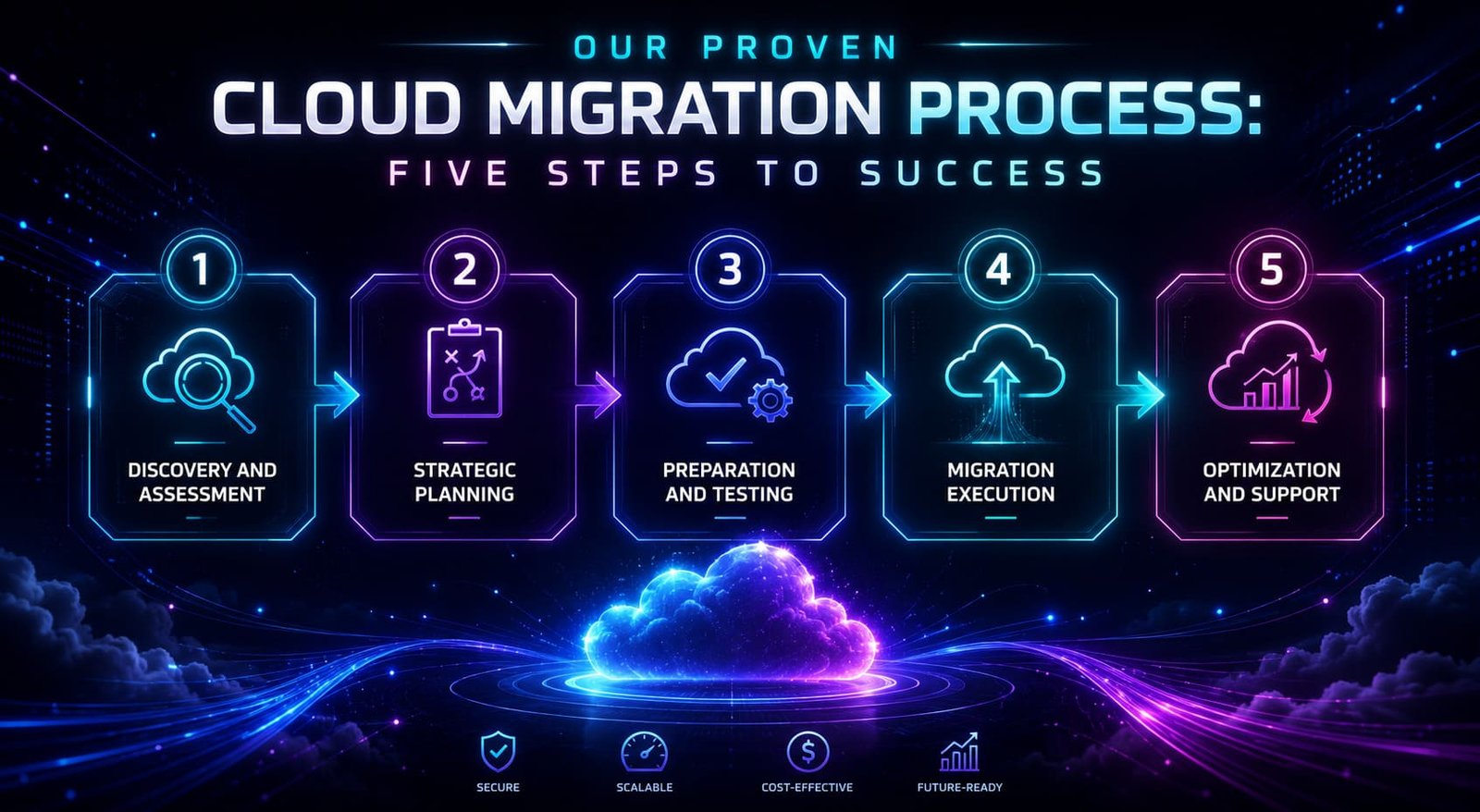
Our Proven Cloud Migration Process: Five Steps to Success
Successful cloud migration requires methodical planning and expert execution. Our structured migration process minimizes risk while ensuring complete functionality in your new cloud environment. Continuous support and monitoring are essential to adapt to evolving needs and to optimize performance, ensuring that your cloud infrastructure remains robust and efficient over time.
- Discovery and Assessment – Comprehensive analysis of current infrastructure, applications, and compliance needs.
- Strategic Planning – Customized migration strategy development based on assessment findings and risk mitigation.
- Preparation and Testing – Configuration of cloud environment and validation through isolated testing.
- Migration Execution – Proven methodologies ensure minimal disruption and continuous monitoring during migration.
- Optimization and Support – Post-migration fine-tuning and ongoing support to maximize efficiency and control costs.
Selecting the Right Cloud Provider for Your Needs
Multiple cloud providers offer robust platforms with different strengths. We maintain expertise across all major cloud environments, enabling us to recommend and implement solutions optimized for your specific requirements. Our team analyzes your unique needs to ensure the best fit, maximizing efficiency and performance. Trust our insights to navigate the complexities of cloud selection effectively.
Major Cloud Platform
Cloud platforms are essential for modern businesses, providing scalable solutions to meet diverse operational needs. Each platform has unique strengths, catering to various industry requirements and preferences. Understanding these differences can help organizations make informed decisions about their cloud strategy.
Amazon Web Services (AWS)
The largest and most mature cloud platform offers the broadest service selection. AWS excels in enterprise deployments requiring extensive integration options and global reach.
- Most comprehensive service catalog available
- Largest global infrastructure footprint
- Extensive third-party tool ecosystem
- Strong machine learning capabilities
Microsoft Azure
Azure integrates seamlessly with Microsoft enterprise software. Organizations heavily invested in Windows environments and Office 365 find Azure particularly advantageous.
- Native Microsoft product integration
- Hybrid cloud capabilities excel
- Strong enterprise security features
- Active Directory integration simplifies management
Google Cloud Platform
Google Cloud emphasizes data analytics, machine learning, and containerized workloads. Organizations prioritizing these capabilities benefit from Google’s technical leadership.
- Advanced analytics and AI tools
- Kubernetes and container expertise
- Competitive pricing models available
- Strong network infrastructure globally
Multi-Cloud Strategy
Some organizations benefit from distributing workloads across multiple cloud providers. This approach optimizes costs, enhances reliability, and prevents vendor lock-in.
- Leverage best features from each platform
- Reduce dependency on single provider
- Optimize costs through competitive positioning
- Enhanced disaster recovery capabilities
We evaluate your applications, workloads, and business requirements to recommend the cloud provider or multi-cloud strategy delivering optimal value. Our platform-agnostic approach ensures recommendations prioritize your needs over provider preferences. Additionally, we continuously monitor industry trends and emerging technologies to adapt our strategies, ensuring you remain competitive and agile in a rapidly evolving landscape.
Cloud Cost Management: Maximizing Your Investment Value
Cloud environments offer significant cost advantages, but only when properly managed. Without active optimization, cloud costs can exceed expectations. Our management services include comprehensive cost control ensuring you extract maximum value from cloud investments. Continuous monitoring and strategic adjustments are essential to adapt to changing usage patterns and market conditions.
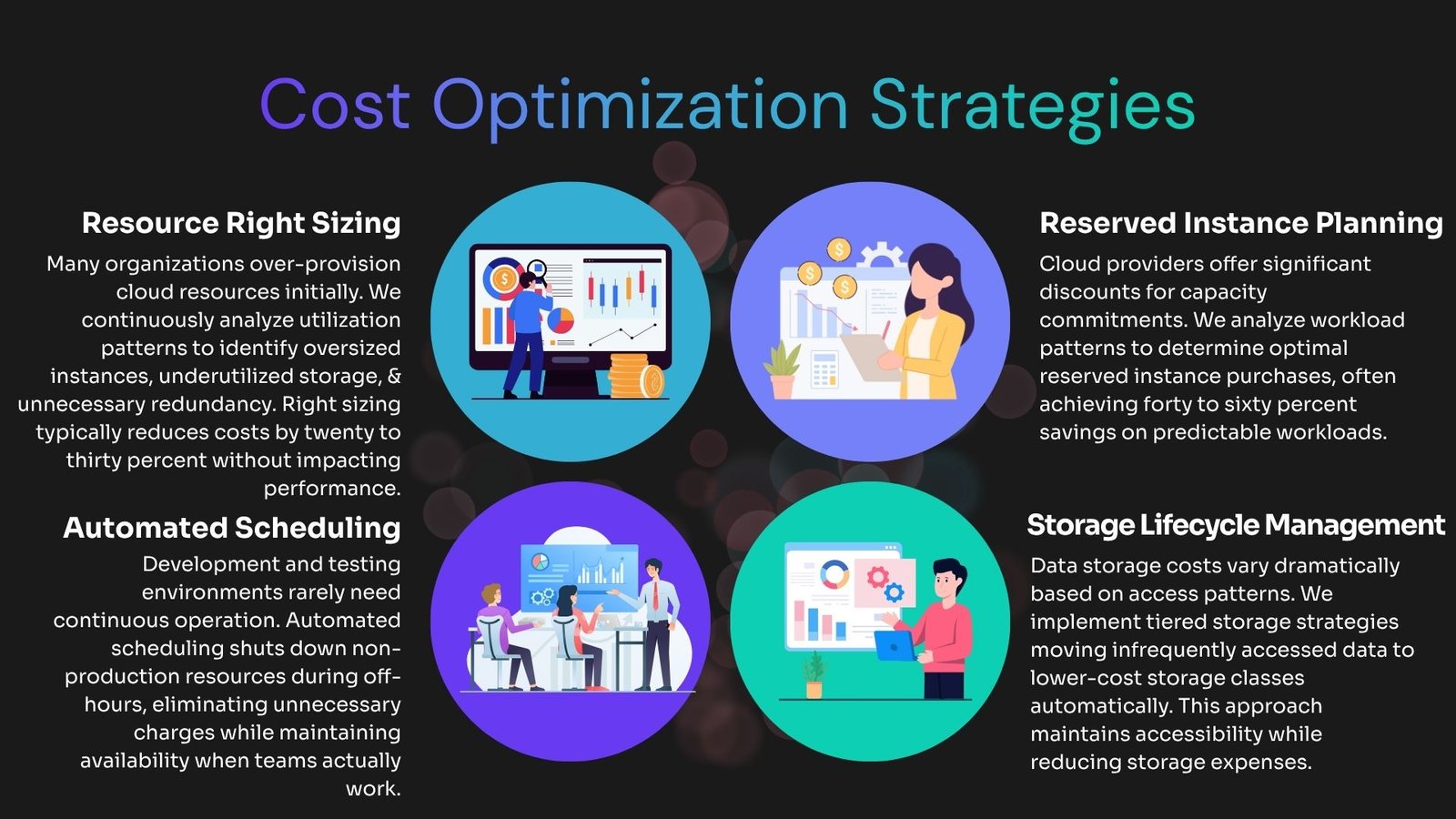
Cost Optimization Strategies
- Resource Right-Sizing: We analyze resource usage to identify and reduce over-provisioned instances, cutting costs by 20-30% without performance loss.
- Reserved Instance Planning: We assess workload patterns to optimize reserved instance purchases, achieving 40-60% savings on predictable workloads.
- Automated Scheduling: We automate the shutdown of non-production resources during off-hours to eliminate unnecessary charges while ensuring availability during work hours.
- Storage Lifecycle Management: We implement tiered storage strategies that automatically move infrequently accessed data to lower-cost storage, reducing expenses while maintaining accessibility.
Overcoming Common Cloud Migration Challenges
Every cloud migration faces potential obstacles. Understanding these challenges and implementing proven solutions ensures successful transitions. Our experience across hundreds of migrations enables us to anticipate and address issues before they impact your business. Moreover, strategic planning and ongoing adjustments are crucial for navigating evolving cloud landscapes, allowing organizations to maximize their cloud investments and achieve their goals efficiently.
Technical Challenges and Solutions
In the rapidly evolving landscape of cloud computing, addressing technical challenges is crucial for successful migration. Our comprehensive approach ensures that potential issues are identified early, allowing for effective solutions to be implemented seamlessly.
Legacy Application Compatibility
Older applications may not function properly in cloud environments without modification. We assess compatibility during discovery and develop modernization strategies. Options include containerization, refactoring specific components, or maintaining hybrid environments where legacy systems remain on-premise while newer applications migrate to cloud platforms.
Data Transfer Complexity
Large data volumes create transfer challenges. Network bandwidth limitations can extend migration timelines significantly. We implement multiple strategies including incremental transfers, compression, data deduplication, and physical data transfer services for massive datasets. These approaches minimize transfer time while ensuring data integrity throughout the process.
Application Dependencies
Complex application ecosystems involve numerous interdependencies. Applications communicate with databases, integrate with third-party services, and rely on specific network configurations. We map all dependencies during assessment and migrate related components together, maintaining functionality throughout the transition.
Performance Consistency
Applications must maintain performance levels in cloud environments. We conduct extensive performance testing before production migration. Load testing validates that cloud configurations handle peak usage effectively. Monitoring during migration identifies performance degradation immediately, enabling rapid correction and adjustments as necessary.
Organizational Challenges
Technical obstacles represent only part of migration challenges. Organizational factors significantly impact success. Change management, team training, and process adaptation require attention equal to technical implementation.
Skills Gap Management
Cloud platforms require different expertise than traditional infrastructure. We provide comprehensive training for your IT teams during and after migration. Knowledge transfer ensures your staff can manage cloud environments confidently.
Our documentation includes operational procedures, troubleshooting guides, and best practices specific to your implementation. Support continues post-migration as teams develop cloud expertise.
Business Continuity Planning
Migration cannot disrupt business operations. We develop detailed continuity plans including rollback procedures if issues arise. Most migrations execute with zero downtime through careful planning and phased approaches.
Communication plans keep stakeholders informed throughout the process. Regular status updates provide visibility into progress while issue escalation procedures ensure rapid problem resolution.